What Is a Software-Defined Vehicle, Really — and Why Automakers Keep Redefining It
The term “software-defined vehicle” (SDV) appears in nearly every major automaker’s strategy deck. Yet the phrase is used so loosely that it risks losing meaning. For some, it simply means more over-the-air updates. For others, it implies a fundamental shift in how vehicles are designed, built, and monetized.
At Auto Stack Report, we cut through the hype to examine what SDV actually requires and why so many companies continue to stretch the definition.
The Core Idea Behind SDVs
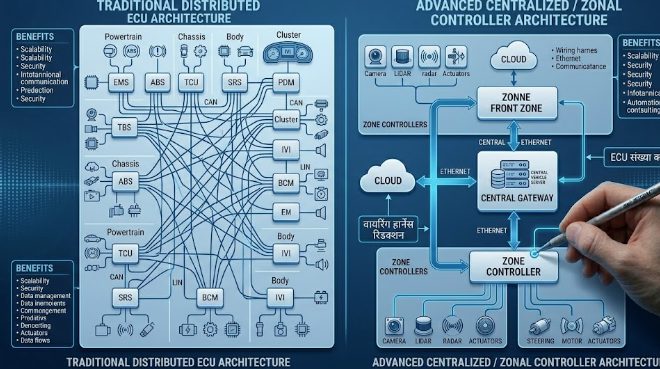
In traditional vehicles, hardware and software are tightly coupled. Most functions are fixed at the time of manufacturing, with limited ability to change after delivery. A software-defined vehicle aims to separate software from hardware, allowing automakers to update, improve, and even add new features throughout the vehicle’s lifespan — much like smartphones.
This requires several foundational elements:
Centralized computing architecture with high-performance domain controllers or zonal controllers
Standardized hardware abstraction layers
Robust over-the-air (OTA) update infrastructure capable of handling safety-critical systems
Data collection and analytics pipelines to support continuous improvement
A development culture that treats software as a long-term product rather than a one-time deliverable
When these pieces are in place, automakers can theoretically deploy new features, improve performance, and create new revenue streams through subscriptions or paid upgrades.
Why the Definition Keeps Shifting
Automakers have strong incentives to claim SDV leadership. The promise of recurring software revenue is compelling in an industry facing margin pressure from electrification and rising component costs. However, true SDV implementation demands massive upfront investment in engineering, cybersecurity, and validation processes.
As a result, many companies apply the label to more modest efforts:
Enhanced infotainment OTA updates
Expanded advanced driver-assistance features
Improved user interface customizations
These are valuable improvements, but they fall short of a fully software-defined architecture where the majority of vehicle functions can be updated independently of hardware constraints.
Current Industry Progress
Some players are further along than others. Companies investing in new electrical/electronic (E/E) architectures are building toward zonal controllers that reduce wiring complexity and enable better software portability. Others continue relying on distributed ECUs (electronic control units) with limited upgrade potential.
The gap between ambition and execution is particularly visible in OTA capabilities. While many new vehicles now support OTA for infotainment, far fewer can safely update propulsion or core safety systems at scale. Supporting updates for 10+ years across millions of vehicles introduces significant technical debt and liability questions that few have fully solved.
Key operational challenges include:
Ensuring update integrity and rollback safety
Managing version compatibility across diverse hardware configurations
Balancing cybersecurity requirements with update frequency
Gaining regulatory approval for safety-critical updates
Business Implications
The hardware story and the margin story are not the same. Even if automakers master the technical requirements, they still face consumer resistance to subscription models for features once considered standard. Building recurring revenue requires not just technical capability but sustained customer trust.
For suppliers, the shift toward SDV changes power dynamics. Traditional Tier 1s must evolve from providing fixed hardware modules to delivering software-capable platforms. Semiconductor vendors offering integrated compute solutions stand to gain, but only if automakers successfully transition away from fragmented architectures.
What Readers Should Watch
For professionals and serious observers, the most important signals are not flashy feature announcements but architectural decisions:
Adoption of centralized or zonal E/E architectures
Investment scale in dedicated software organizations
Transparency around OTA success rates and update scope
Long-term support commitments for specific vehicle platforms
These indicators reveal who is making genuine progress toward software-defined capabilities versus those primarily updating their marketing language.
The Practical Question
Software-defined vehicles offer real potential for faster innovation cycles and improved customer experience. However, the transition requires more than rebranding existing update capabilities. It demands deep architectural changes, new operational processes, and a fundamental shift in how automakers allocate engineering resources.
Most companies are somewhere in the middle of this journey. Some are making credible progress. Others risk overpromising on timelines and economics. The real test will be whether they can deliver meaningful software differentiation at scale while maintaining — or improving — vehicle margins.
We will continue tracking these developments with focus on execution realities rather than slide-deck ambitions.