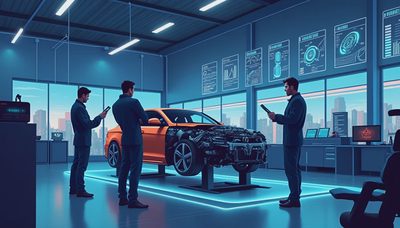
The automotive industry is undergoing a massive shift toward software-defined vehicles, and **Automotive Technologies Inc** is emerging as a key player in this transformation. From autonomy stacks to in-car operating systems, the company is positioning itself at the intersection of hardware and software. But the real question is whether their approach can scale beyond demos and deliver real margins. This article dives into how Automotive Technologies Inc is navigating the cost curve, its bets on semiconductor design, and what it means for suppliers and automakers.
The Rise of Automotive Technologies Inc in the Autonomy Stack
When we talk about autonomous driving, most attention goes to sensor suites and AI models. But the underlying compute platform is just as critical. **Automotive Technologies Inc** has developed a domain-specific architecture that claims to reduce power consumption by 30% compared to off-the-shelf GPU solutions. Their focus on functional safety (ISO 26262 ASIL-D) makes them a credible alternative for production programs. Several Tier-1 suppliers are already evaluating their chipset for L2+ systems. However, the hardware story and the margin story are not the same story—volume commitments remain the missing link.
How Automotive Technologies Inc Approaches Car Software and Semiconductors
Unlike traditional chipmakers who rely on foundry relationships, **Automotive Technologies Inc** has invested in its own design tools and middleware layer. This vertical integration allows tighter optimization for tasks like sensor fusion and path planning. The company also offers a virtual simulation environment that reduces the need for hardware-in-the-loop testing, cutting development costs by an estimated 20%. This is a good demo, but harder business: automakers often prefer decoupled supply chains to avoid lock-in. Still, for specific use cases like parking assistance and highway pilot, the integrated approach has appeal.
The Business Case: Scaling Without the Hype
**Automotive Technologies Inc** has avoided the high-profile SPAC route, instead raising capital through strategic partnerships with two major OEMs. Their revenue model combines upfront license fees for the chip design with per-vehicle royalties for the software stack. Early projections suggest break-even at around 500,000 vehicles per year—a target that seems ambitious given current L2+ adoption rates. The company argues that its flexible licensing allows smaller EV startups to access advanced capabilities without massive R&D budgets. That could be a wedge, but the total addressable market for such integrated solutions remains uncertain.

Challenges Ahead for Automotive Technologies Inc
No company in this space faces a smooth road. **Automotive Technologies Inc** must compete with established players like Nvidia and Qualcomm, as well as internal programs from Tesla and others. The semiconductor shortage has amplified the importance of secure supply chains; Automotive Technologies Inc relies on a single foundry for its current generation, which is a concentration risk. Additionally, software-defined vehicles require continuous OTA updates and cybersecurity certifications—areas where startups often stumble. The company's track record on reliability is still thin, and automakers are risk-averse when safety is on the line.
What This Means for the Industry
If **Automotive Technologies Inc** succeeds, it could accelerate the transition toward more specialized, integrated compute platforms in vehicles. For investors and industry watchers, the key metric is not just technical specs but design win counts and program milestones. The company's approach to bundling hardware and software might become a template for other startups. However, until we see production vehicles hitting the road with their silicon inside, skepticism remains healthy. The real question is whether this scales—and that depends on execution, not just engineering.
Frequently Asked Questions About the Company's Strategy
**1. How does this company differentiate from traditional chip suppliers?**
Unlike established players that offer generic compute platforms, this company focuses on a vertically integrated hardware-software stack optimized for automotive safety and latency. This approach reduces power consumption and development time but requires automakers to commit to a single architecture. In contrast, Nvidia’s Drive platform allows more flexibility but at higher power draw.
**2. What is the biggest risk for the company?**
The primary risk is design-win concentration. If only one or two OEMs adopt their platform, the revenue base remains narrow. Additionally, reliance on a single foundry for chip fabrication introduces supply chain vulnerability. A second-source agreement could mitigate this, but none has been announced yet.
**3. Can smaller automakers afford their solution?**
Yes, the company’s per-vehicle royalty model lowers upfront costs compared to building in-house autonomy systems. This makes advanced capabilities accessible to EV startups with limited R&D budgets. For example, a startup developing a delivery pod could license the entire stack without hiring a large AI team.
**4. When will we see production vehicles using their technology?**
According to public announcements, the first vehicles with their chipset are expected in late 2025. However, automakers often delay software validation, so timelines remain fluid. If successful, these initial launches will prove the platform's reliability at scale.
**5. What kind of partnerships has the company formed?**
The company has strategic partnerships with two major OEMs for co-development and funding. These collaborations provide validation but also tie their roadmap to their partners’ product cycles. The company has also opened early-access programs for Tier-1 suppliers. Such partnerships are crucial for securing the design wins needed to reach volume production.
In summary, **Automotive Technologies Inc** represents a compelling bet on the convergence of automotive engineering, software, and supply chain economics. The next 12-18 months will be crucial to see if their products move from prototype to volume production. Whether they become a major supplier or a niche player, their journey offers valuable lessons for the entire mobility ecosystem.