Why We’re Covering Car Tech Like an Industry System, Not a Product Launch Feed
The automotive industry is in the middle of its most significant transformation in decades. Software, sensors, semiconductors, and new energy systems are redefining what a vehicle is and how companies make money from it. Yet much of the coverage around these changes still treats every press release and demo as a breakthrough.
At Auto Stack Report, we take a different approach. We cover autonomous systems, car software, chips, charging infrastructure, and the cost economics that ultimately decide winners not as isolated product stories, but as an interconnected industrial system.
The Problem With Launch-Driven Coverage
Most days bring multiple announcements: new autonomy features, bigger battery packs, faster chips, or expanded charging networks. Many outlets report these as discrete wins. A smoother ride in a demo becomes “major progress toward robotaxis.” A new software update is framed as proof that a company has “solved” a complex engineering challenge.
This style of coverage is easy to consume but often misses the harder questions that matter to professionals, suppliers, investors, and serious observers:
Can this actually ship at meaningful scale?
What does it really cost to deploy and maintain?
Who controls the critical parts of the technology stack?
What breaks when you move from controlled testing to real-world operations?
These are the questions we will ask consistently.
Autonomy as a Systems Challenge
Autonomous driving provides the clearest example. Progress in perception, planning, and control algorithms is real. Yet turning that progress into unsupervised, economically viable robotaxis involves far more than software updates.
It requires sensor strategies that perform reliably in snow, rain, and glare. It demands safety cases that regulators and the public can trust. It needs compute platforms that deliver performance without destroying vehicle margins. Most importantly, it requires operational design domains that make business sense at scale.
When we cover Waymo, Cruise, Tesla FSD, Mobileye, or new entrants, we will examine not just capability claims but the full picture: cost per mile, fleet utilization, regulatory posture, infrastructure dependencies, and fallback mechanisms. Good demos are necessary. Durable product progress is something else entirely.
The Stack Matters
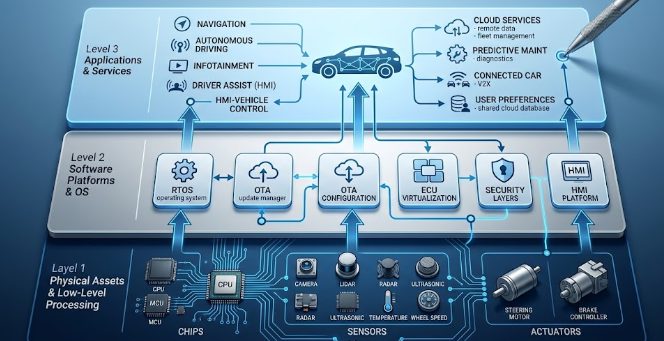
No single company builds the modern vehicle alone. Automotive technology today is a layered stack involving automakers, Tier 1 suppliers, semiconductor vendors, software platforms, and charging network operators.
A decision in the autonomy stack affects semiconductor demand. A choice in battery architecture influences charging standards and grid requirements. Software monetization strategies only work if the underlying hardware and update infrastructure are reliable for a decade or more.
Our coverage will trace these connections rather than treating each announcement in isolation. When a company touts a new in-car OS or chip platform, the real story often lies in control points, supply chain resilience, and unit economics.
What Readers Can Expect
This site is built for readers who want more than headlines. Our primary audience — engineers, product managers, strategy professionals, investors, and informed enthusiasts aged roughly 25–45 — already follows the major players. They need context, trade-off analysis, and clarity on what developments actually move the industry needle.
Core coverage pillars include:
Autonomy Stack: Sensor strategies, compute choices, safety validation, and deployment realities.
Car Software: Operating systems, OTA infrastructure, cockpit experience, and software-defined vehicle execution.
Chips & Supply Chain: Semiconductor platforms, sourcing risks, and the battle for control of the vehicle’s compute.
Charging & Battery Systems: Network reliability, thermal management, standards competition, and infrastructure constraints.
The Cost Curve: How technology decisions translate into platform costs, margins, and sustainable business models.
We will publish daily on significant developments, with faster updates on earnings, regulatory actions, and major incidents. Weekly roundups and deeper explainers will help connect the dots.
A Skeptical but Not Cynical Lens
We are not anti-innovation. The shift toward software-defined vehicles, advanced driver assistance, and electrification represents genuine engineering and business opportunity. However, confusing investor storytelling with operational reality has consequences — misallocated capital, disappointed customers, and regulatory backlash.
Our editorial standard is straightforward: distinguish between what companies can demonstrate today and what they must deliver at scale, profitably, and reliably. We will highlight strong technical execution where it exists and question optimistic timelines and economics when evidence is thin.
The Real Question
Every significant development in automotive technology eventually faces the same test: does this improve the product in ways customers value while preserving or expanding manufacturer and supplier margins? The hardware story and the margin story are rarely the same.
This is why Auto Stack Report exists — to provide clear-eyed, systems-level analysis of the technologies reshaping mobility. Not every announcement deserves equal attention. Not every claimed breakthrough is one. Our job is to separate signal from noise and explain what the changes actually mean for the industry and its participants.
We look forward to earning your time with rigorous, useful coverage grounded in deployment realities rather than launch excitement.