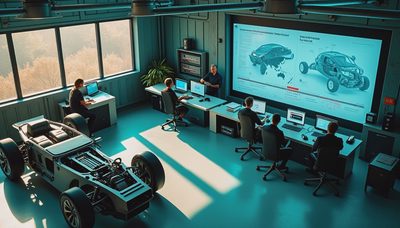
If you have asked "what is motor vehicle software corp," you are seeing the industry shift toward software-defined vehicles. A motor vehicle software corp develops the code that runs everything from the infotainment screen to the automatic emergency braking system. This is not a single company name but a category of businesses that create and maintain the digital backbone of modern automobiles. As cars become more like smartphones on wheels, understanding these corporations matters for anyone following automotive technology.
Defining Motor Vehicle Software Corp
A motor vehicle software corp is a company that specializes in developing, integrating, and licensing software for cars, trucks, and other road vehicles. This includes embedded systems, advanced driver assistance system (ADAS) algorithms, over-the-air update platforms, and vehicle-to-everything (V2X) communication stacks. Some firms focus on a single layer, like infotainment operating systems, while others offer a full-stack solution covering everything from the hypervisor to the cloud backend. The term covers both established suppliers like BlackBerry QNX and newer players entering the space.
These corporations typically work directly with automakers (OEMs) or with tier-1 suppliers. They rarely sell finished cars. Instead, they license their software per vehicle or charge recurring fees for maintenance and updates. The rise of electric vehicles and autonomous driving has accelerated demand for their services, as legacy mechanical engineering alone no differentiates vehicles.

Core Functions These Corporations Handle
What does a motor vehicle software corp actually build? The scope is broad. At the lowest level, they produce real-time operating systems (RTOS) that control safety-critical functions like braking and steering. These systems must meet functional safety standards such as ISO 26262. Above that, they provide middleware that connects sensors, ECUs, and actuators. This middleware handles data fusion from cameras, radar, and lidar to create a unified environment model for ADAS.
Another key area is infotainment and connectivity. A motor vehicle software corp might develop the entire Android Automotive OS implementation or build the telematics control unit software that manages cellular and Wi-Fi connections. They also handle cybersecurity, including secure boot, encryption, and intrusion detection systems that protect against remote attacks. Over-the-air update software is another specialty, enabling OEMs to fix bugs and add features without dealership visits.
Finally, many of these corporations offer development tools and simulation environments. These tools allow automakers to test software in virtual worlds before deploying it to real vehicles. Without this, developing ADAS and autonomous functions would be far more expensive and time-consuming.
Why This Market Matters for Automakers
Automakers are under pressure to deliver software experiences that rival consumer electronics. A motor vehicle software corp provides the specialized expertise that car companies often lack. Building a robust, secure, and upgradable software stack in-house is enormously complex and expensive. Most OEMs cannot justify the R&D cost for every layer, especially when they produce low-volume models.
By partnering with a motor vehicle software corp, automakers can focus on brand-specific features (seat comfort, driving dynamics, styling) while outsourcing the standardized software layers. This speeds time-to-market and reduces risk. It also enables a recurring revenue stream through software subscriptions, a model that many OEMs are beginning to adopt. For example, a navigation upgrade or a performance boost can be sold after the vehicle is purchased, generating profit long after the initial sale.

The Business Model Behind Automotive Software
A motor vehicle software corp typically earns revenue through upfront license fees and per-vehicle royalties. Some firms charge a flat fee per development project, while others take a percentage of the subscription revenue if the software enables paid services. The trend is toward platform-based models, where the software corporation provides a hardware-agnostic stack that can be reused across multiple vehicle lines.
This allows economies of scale. The same middleware might run on a cheap compact car and a luxury SUV, with different calibration settings. The software corp's profitability depends on how many vehicles their code ends up in. Successful firms can achieve high margins because software is replicable at almost zero marginal cost. However, the upfront development investment is substantial, especially for safety-certified software that requires years of validation.
The Future of Motor Vehicle Software Corp
Looking ahead, the line between hardware and software will blur further. As cars move toward zonal or centralized architectures, the need for complex middleware and virtualization will grow. A motor vehicle software corp will need to support heterogeneous computing platforms, mixing CPUs, GPUs, and AI accelerators from different chipmakers.
Open-source software is also playing a bigger role. Projects like AUTOSAR and AGL (Automotive Grade Linux) reduce proprietary lock-in, but they also create integration challenges. The motor vehicle software corp of tomorrow will be a system integrator as much as a developer. Companies that can combine open-source components with proprietary safety and security layers will have an edge.
Another frontier is data management. Vehicles generate terabytes of data per hour when operating in autonomous mode. Software corporations that offer edge computing, data pipelines, and analytics platforms will capture additional value. The question is whether these corporations can scale their offerings across different OEMs and regions without becoming too fragmented.
For anyone asking "what is motor vehicle software corp," the answer is not a single company but a vital ecosystem. These corporations enable the rapid innovation we see in electric and autonomous vehicles. Without them, the promise of software-defined vehicles would remain locked in engineering labs. Their role will only expand as cars become more connected and intelligent.